
- Client
- Atlas of Today's World, z. s., Prague
- What we did
- Website design and development, content management system, SEO and GEO
- Tech stack
- Next.js, Supabase, Vercel, MapTiler, Stripe
- Website
- atlasoftodaysworld.org
The briefWhat did Atlas need?
A website that turns an encyclopedia into an experience, and the experience into a reliable source. Atlas of Today's World is a nonprofit, open encyclopedia of the present-day world. It is published by an association founded in 2016, and everything is free to read without an account. The content combines texts by experts with data from international institutions such as UNDP, the World Bank, V-Dem and Transparency International.
Atlas wants people to read it and cite it. Today, that means two audiences: readers coming from search engines, and AI assistants that look for answers on their behalf. So the website had to make sense to both.
The solutionWhat did we build?
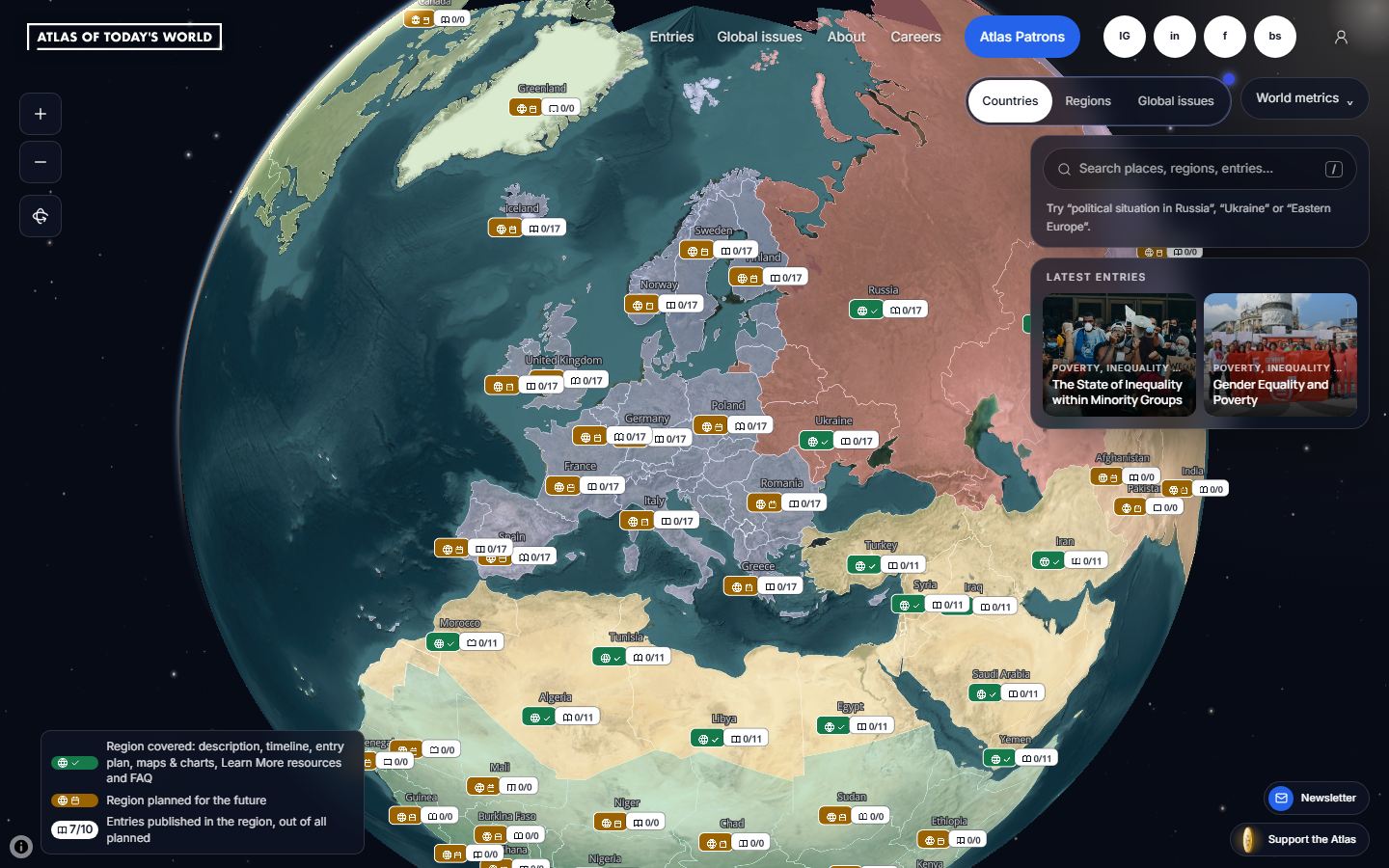
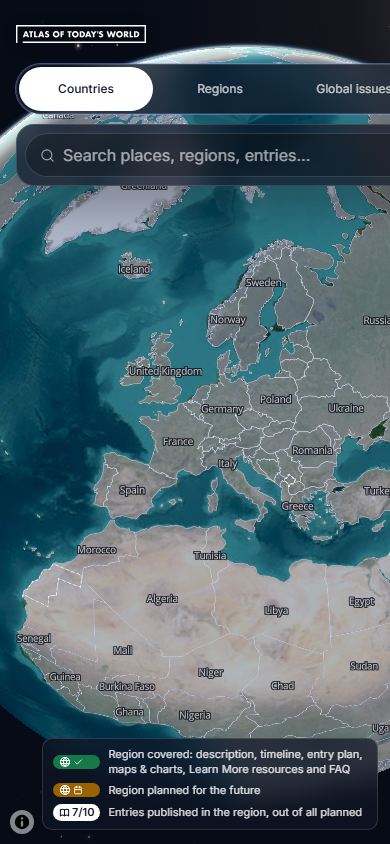
An interactive atlas, a content management system and donor support in one website. Visitors spin the satellite globe, click a country or region and read its profile. Meanwhile, the editors write entries in the admin panel and track how many are still missing in each region.
-
A 3D globe with data layers
A satellite globe with switchable layers, such as the Human Development Index, political regime or perceived corruption. Every value states its source and year.
-
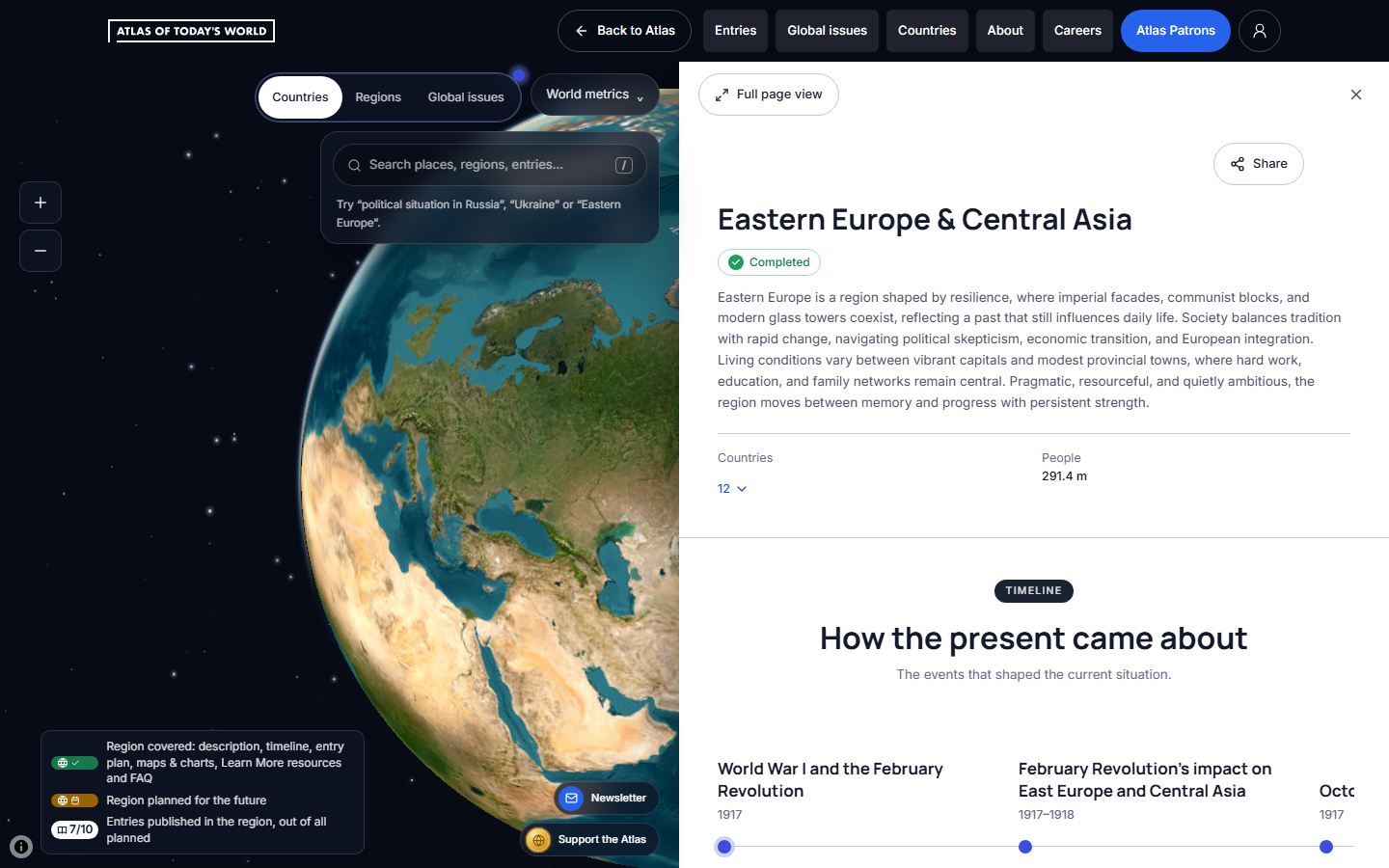
Profiles of 228 countries and 10 regions
A description, timeline, entry plan, maps and charts, further reading and an FAQ. Each region shows how many entries have been published so far, for example 7 out of 10.
-
A custom CMS
An admin panel with user roles, author invitations and management of entries, authors and country portraits. Data and authentication run on Supabase.
-
Support without tracking
Atlas Patrons membership with payments through Stripe, a newsletter and bot protection for forms. The website uses only essential cookies and counts visits without them.
SEOHow does Google find it?
Every page is generated in advance, described with structured data and listed in a sitemap. Search engines don’t have to guess anything. The website is built with Next.js and hosted on Vercel, so readers and crawlers alike get fully rendered pages without waiting for JavaScript.
URLs in 6 topical sitemaps: pages, regions, countries, data, entries and authors.
points for SEO, accessibility and best practices in Lighthouse, on both mobile and desktop.1
structured data types on the home page, ranging from the nonprofit itself to its datasets.
- An organization with an identity: NGO structured data with the registration number, address, founding date and a link to its Wikidata entry. This lets search engines and AI tie Atlas to a specific organization.
- Entries as articles: every entry marks up its author as a Person, along with publication and last-updated dates and breadcrumbs.
- Data as datasets: indicators are described as Dataset and DataCatalog, so dataset search can find them too.
- On-site search: WebSite with SearchAction shows Google how to search Atlas.
GEOHow does AI cite it?
Atlas locks nothing away from AI assistants and serves its content in a form they can cite precisely. GEO, or generative engine optimization, is mostly about content. Research presented at KDD 2024 found that citing sources and adding statistics increase a page’s visibility in AI answers by roughly 28% to 33%.2 Atlas is built exactly that way: every value has a source and a year.
- AI search engines explicitly allowed. The robots.txt file names and allows the crawlers of ChatGPT, Claude, Perplexity, Mistral and other AI search engines.
- llms.txt with citation instructions. An overview of the content for language models, including a “Cite as” line with the exact citation format.
- All content in one file. llms-full.txt holds the full text of every entry, 788 KB in total.
- Markdown for every article. Add .md to the URL and AI gets clean text without navigation or scripts.
- RSS and Atom. New content reaches aggregators and crawlers automatically.
- Author and dates on everything. Every article shows its author, publication date and last update, which AI and Google treat as signs of trustworthiness.
Lighthouse, Atlas home page
Points out of 100, measured on October 27, 2026. Dark bars: desktop. Light bars: mobile.